Hyderabad: On August 9, a tragic incident occurred in Hanamkonda district where a YouTuber and his nine-year-old daughter were found dead by suicide. The deceased, identified as 36-year-old Gattigopula Yogi Reddy and his daughter Adya, were discovered hanging near Ekasila Park.
The father and daughter had left their home in the morning and failed to return. When Reddy’s wife was unable to contact him, she reached out to their relatives. Together, they went to Ekasila Park, where they found both hanging.
While Reddy was pronounced dead at the scene, Adya was still alive when discovered. She was rushed to the hospital but unfortunately succumbed to her injuries shortly thereafter.
Police investigations suggest that financial difficulties may have been a contributing factor to this tragic decision. Reddy was employed as an online journalist with V6 News Telugu.
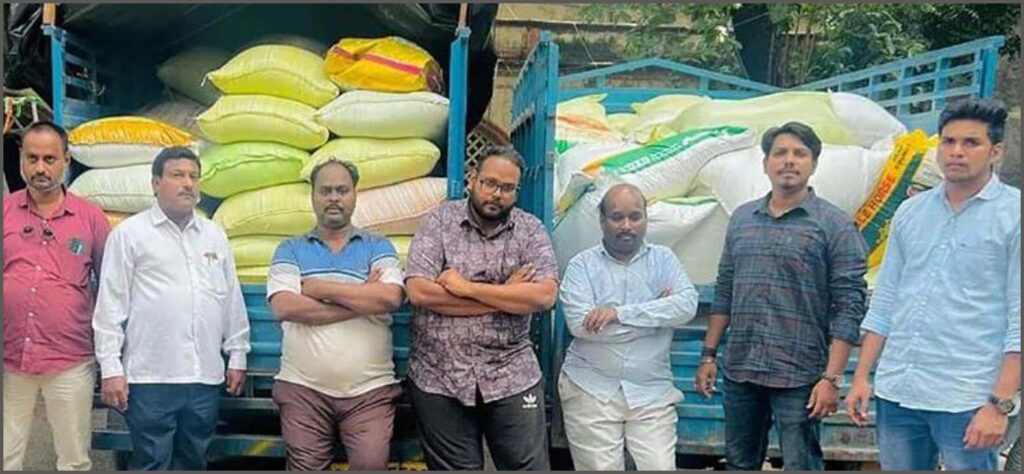
Hyderabad: On Saturday, August 10, the city police dismantled a public distribution system (PDS) rice and wheat racket in Gazia-E-Millat Colony, Chandrayangutta. The operation led to the arrest of three individuals and the seizure of food grains valued at ₹3,25,000, including 14 tones of rice and 15 quintals of wheat.
The arrested individuals have been identified as Mohd Rizwan, 28, from Chandrayangutta; V Rajnikanth alias Chinna, 42; and V Rajeshwar alias Raju, 44, both from Uppuguda.
Four co-accused remain at large. They are Fatheh alias Chacha and Faqru, residents of Chandrayangutta; Kiran from Uppuguda; and Sai from Chatrinaka. The Hyderabad police are actively working to apprehend these absconding suspects.
According to police reports, the primary accused Rizwan, a car driver by profession, sought quick financial gain by collaborating with Fatheh alias Chacha to engage in illegal PDS food grain smuggling. They purchased PDS grains from consumers at low prices and sold them at a higher rate in other states. The operation was later expanded with the involvement of V Rajnikanth, V Rajeshwar, Kiran, Sai, and Faqru, who facilitated the procurement and distribution of the food grains.
The arrests were made by the Commissioner’s Task Force, South Zone, in collaboration with Chandrayangutta police and civil supplies officials from Yakutpura.
The Chandrayangutta police have filed a case and are conducting further investigations to arrest the remaining suspects and take additional action.
Hyderabad: The Telangana Anti Narcotics Bureau (TGNAB) has arrested a software engineer from Khammam for allegedly ordering drugs through the dark web.
The engineer, whose identity has not been disclosed, placed the order on July 31 and paid for the drugs using cryptocurrency. The vendor, located in Assam, discreetly sent the drugs via speed post, concealed under brown tape on a newspaper. The software engineer received the package on August 8.
Acting on a tip-off, TGANB’s technical wing, in collaboration with RNCC Khammam and local police, apprehended the software engineer. The individual is currently undergoing counseling by the authorities.
Since the establishment of TGANB, numerous drug traffickers and consumers, both domestic and international, have been apprehended, significantly curtailing illegal activities in Telangana. Continuous tracking and monitoring have driven most offenders to either leave the state or reduce their operations.
Despite relentless efforts by the government and law enforcement agencies, why does the drug menace continue to thrive? Isn’t it the responsibility of parents to keep a vigilant eye on their children? Parents should take proactive steps to steer their children away from harmful influences. Is any job or responsibility so demanding that it justifies compromising the safety and well-being of one’s own children?
Hyderabad: On Friday, August 9, the Rachakonda police arrested two individuals accused of running a matrimonial fraud scheme.
The accused, K Surya Prakash, 33, a share market trader from Bhadradri-Kothagudem, and S Satish, 33, from Kakinada, were involved in conning people through matrimonial sites. Prakash, who was previously duped by a reputed matrimony site, teamed up with Satish to target others.
Using fake details and photos of attractive women, the duo registered on various matrimonial sites. They would initiate conversations with match seekers, asking about their family background and exchanging photos on WhatsApp. Once the victims were emotionally invested, they would request money for reasons such as parental health issues, educational fees, or business losses. To further deceive, they used voice changers to imitate female voices.
Following a complaint from a victim, the Cybercrime police booked a case and apprehended the duo. They were also linked to a similar case in Rachakonda and three other cases across the state.
The arrested cybercriminals have been charged under Cr. No. 105/2024 U/s 406, 419, 420 of IPC and Sec. 66-C, 66-D of the IT Act at CyberCrimeRck PS, Rachakonda.
(Even in Modern Times, the Business of Fake Babas is Thriving)
Kanpur: In Uttar Pradesh’s Hathras, Suraj Pal, also known as Bhole Baba, turned from a police officer into a self-proclaimed saint, leading to the deaths of hundreds due to his superstitions. Yet, people continue to fall for the fake “miracles” of such babas. Similarly, in a village in Kanpur, a baba is exploiting people’s faith in the name of treatment, playing with their lives.
According to the news portal Aaj Tak, this baba is allegedly driving away evil spirits by giving women bottled water for ₹20, which he claims openly on stage. He asserts that evil spirits flee from here to as far as America. This baba is known as Hari Om Maharaj, the head of a Shakti Peeth ashram in Chaynka Purva village in the Deorahat police station area.
Recently, this baba has started a business of deception. Several videos from his court have surfaced. In one video, a woman can be seen flailing her hair in front of the baba’s stage, feeling the presence of some evil spirit within her. A man is seen dragging her by the hair towards the baba, who, like other fake babas, is expanding his empire of fraud.
Claims of Curing Diseases from Cancer to Diabetes…
Baba Hari Om claims that the water here cures everything from cancer to diabetes. He performs a fake ritual of blowing on tap water, chanting mantras, and claims to turn it into nectar, persuading people to drink it.
Nectar Water Sells for ₹20…
Baba Hari Om charges innocent people ₹20 for this so-called nectar water. Men and women troubled by evil spirits are flocking to Baba Hari Om’s ashram. In the pictures, you can see that the baba’s disciples are also spreading their web of deceit all around. When the media tried to talk to Baba Hari Om, he refused to say anything, claiming that he didn’t have God’s permission. The devotees who come to Baba’s satsangs are also reluctant to speak much, but it’s clear that a crowd of innocent villagers has gathered at Baba’s ashram. The baba’s disciples remain constantly around his stage.
Hyderabad: Osmania University, one of the oldest universities in India, has announced that it will no longer conduct entrance tests for PhD admissions. Moving forward, students aspiring to pursue PhD programmes at the university will need to qualify through the University Grants Commission (UGC) – National Eligibility Test (NET).
The decision comes in response to a directive from the UGC, which has instructed universities to use NET scores for PhD admissions instead of conducting separate entrance exams.
Prof. P Laxminarayana, Registrar of Osmania University, confirmed the change, stating, “As per the instructions from the UGC, PhD admissions will now be based solely on NET scores, and the university will not conduct PhD entrance tests. We have already begun PhD admissions under category – I JRF.”
Starting June 2024, the UGC will declare NET eligibility in three categories:
Category I: Candidates eligible for PhD admission with Junior Research Fellowship (JRF) and appointment as an assistant professor.
Category II: Candidates eligible for PhD admission without JRF and for appointment as an assistant professor.
Category III: Candidates eligible only for PhD admission without JRF and the assistant professor position.
Previously, Osmania University admitted students into PhD programmes under three categories: Junior Research Fellowship (JRF), NET/SET qualified, and PhD entrance test. The university’s PhD entrance tests have faced criticism in the past, with students demanding the qualifying mark be reduced to as low as 15 for admission.
Sisodia Thanks Supreme Court for Slapping Dictatorship with Constitutional Power
Aam Aadmi Party (AAP) leader Manish Sisodia was greeted with chants of “Sisodia, Sisodia” as he walked out of Tihar Jail on Friday evening, ending 17 months of imprisonment. The Supreme Court had granted him bail earlier that day in both the CBI and ED cases related to the now-scrapped Delhi liquor policy.
Upon his release, the former deputy chief minister exclaimed, “Bharat Mata ki Jai! Inquilab Zindabad!” He expressed gratitude to supporters, saying, “We have brought this legal battle to its logical end through the Constitution. I thank you all for being with me… Kejriwal will also come out soon. Our fight is against dictatorship… I have not endured the pain in these 17 months, you all have suffered it. The number of people in this country who love me has increased manifold.”
Sisodia also took to Twitter to express his appreciation for the Supreme Court and Dr. B.R. Ambedkar’s Constitution. He wrote, “I wholeheartedly thank the Supreme Court for slapping dictatorship in the face by using the power of the Constitution. Today, after 17 months, I am out of jail solely because of the Constitution. Babasaheb Ambedkar’s Constitution has protected those who fight against dictatorship. My entire life is indebted to Babasaheb and the Constitution he authored.”
He further expressed his appreciation for former Rajya Sabha member and senior advocate Abhishek Manu Singhvi, thanking him for his legal support.
AAP leaders and party workers gathered at Tihar Jail’s Gate No. 3 to welcome Sisodia, amidst heightened security. Sisodia is expected to visit Chief Minister Arvind Kejriwal’s residence soon.
Justice Gavai, while allowing the appeal, quashed the Delhi High Court’s order and granted Sisodia bail in both the ED and CBI cases, with conditions. The apex court emphasized that “the principle of bail is a rule and jail is an exception.” Sisodia was directed to surrender his passport and refrain from influencing witnesses.
Earlier in the day, Special Judge Bawaje had extended the judicial custody of Sisodia and K Kavitha until the next hearing. However, after the Supreme Court’s order, the Rouse Avenue court issued a release warrant, following the acceptance of Sisodia’s bail and surety bonds by Special Judge Kaveri Baweja.
ACB Team Seizes Cash, Gold, and Passbooks During Raid on Dasari Narendar
Hyderabad: The Anti-Corruption Bureau (ACB) recently raided the residence of Dasari Narendar, the superintendent and in-charge revenue officer of the Nizamabad Municipal Corporation, unearthing assets valued at approximately Rs 6.07 crore.
The raid uncovered significant wealth, including Rs 2.93 crore in cash, Rs 1.10 crore across various bank accounts held by Narendar, his wife, and his mother, 51 tolas of gold worth Rs 6 lakh, and 17 immovable properties valued at Rs 1.98 crore.
Narendar faces charges under Sections 13(1)(b) and 13(2) of the Prevention of Corruption Act, 1988, for accumulating assets far exceeding his income through corrupt means. He has been arrested and will be presented before the Special Judge for SPE and ACB Cases in Hyderabad. The investigation remains active, with further searches expected to reveal additional assets.
Video Available, “Vehement Opposition: Owaisi Rejects Waqf (Amendment) Bill, Declares ‘Aap Muslims Ke Dushman Ho’.”
New Delhi: Hyderabad MP Asaduddin Owaisi criticized the Waqf (Amendment) Bill, 2024, labeling it discriminatory and arbitrary. He accused the Modi-led NDA government of dividing the nation.
“This bill violates the principles of Articles 14, 15, and 25 of the Constitution. It is both discriminatory and arbitrary. By bringing this bill, you (the Central government) are dividing the nation, not uniting it. This bill is evidence that you are an enemy of the Muslims,” Owaisi stated in the Lok Sabha.
Union Minority Minister Kiren Rijiju introduced the bill in the Lok Sabha on August 8. The bill seeks to amend the Waqf Act, 1995, addressing issues related to the powers of State Waqf Boards, the Central Waqf Council, registration and survey of Waqf properties, and removal of encroachments.
Opposition parties in the INDIA bloc, including the Congress, SP, DMK, and NCP (SCP), opposed the bill. They object to provisions like empowering district collectors and including non-Muslims on state Waqf boards and the Central Waqf Council. The bill proposes over 40 amendments, including representation for Muslim women and non-Muslims in Waqf bodies.
The opposition has demanded that the bill be sent to a standing committee for scrutiny. The government will decide on this after assessing the sense of the Lok Sabha.
The night before Bangladeshi Prime Minister Sheikh Hasina’s sudden resignation and departure to India, an online meeting was held by top military officials, chaired by Army Chief General Waqar Zaman. According to Reuters, the decision was made that military personnel would not open fire on civilians to enforce a curfew.
Immediately after the meeting on Sunday night, General Waqar Zaman left for Prime Minister Sheikh Hasina’s residence. The Army Chief informed Sheikh Hasina in her office that the military personnel would not comply with her orders for a nationwide lockdown or curfew.
Bangladesh Army spokesman Lieutenant Colonel Samiul Doula Chaudhary confirmed the high-level military meeting on Sunday, but described it as a routine emergency meeting. When Reuters pressed the army spokesman for more details, he declined to provide further information.
A senior Indian official, who spoke to Reuters on condition of anonymity, stated that Sheikh Hasina received a clear message from General Waqar Zaman that she no longer had the army’s support.
Reuters spoke to several informed sources about the recent events in Bangladesh, including four senior military officers and two other officials. Most provided information on the condition of anonymity.
Details of the high-level military meeting and the subsequent message to Sheikh Hasina of the army’s non-cooperation were not previously disclosed. These details shed light on how Sheikh Hasina’s 15-year-long rule suddenly ended, leading to her resignation and hasty departure to India.
The student movement against the quota system in government jobs had escalated into violent protests demanding Sheikh Hasina’s resignation. The most violent day was Sunday, with clashes, police brutality, and rioting resulting in around 91 deaths.
Following dozens of deaths, Sheikh Hasina’s government decided to impose a nationwide curfew, announced by the military. According to three former senior military officers, the severity of the protests and the resulting governmental actions, causing nearly 300 deaths, made it difficult for the military to continue supporting Sheikh Hasina.
Former Brigadier General Sakhawat Hussain told Reuters that there was significant unrest among military personnel. This unrest likely increased pressure on the Army Chief. Military personnel on duty could see everything happening on the streets.
Two days before Sheikh Hasina’s resignation, Army Chief General Waqar Zaman hinted on Saturday that military support for the Prime Minister was waning. Notably, General Waqar is related to former Prime Minister Sheikh Hasina. He is the son-in-law of former Army Chief General Mustafizur Rahman, who was a cousin of Sheikh Hasina’s father and Bangladesh’s founder, Sheikh Mujibur Rahman. General Mustafiz led the Bangladesh Army from 1997 to 2000 during Sheikh Hasina’s first term as Prime Minister.
On Saturday, General Waqar Zaman addressed junior officers in a meeting attended by many uniformed officers. Seated on a wooden ornate chair, the Army Chief emphasized patience and the protection of civilian lives. This was the first indication that the military would not help suppress the protests by force, marking the beginning of the end for Sheikh Hasina’s rule.