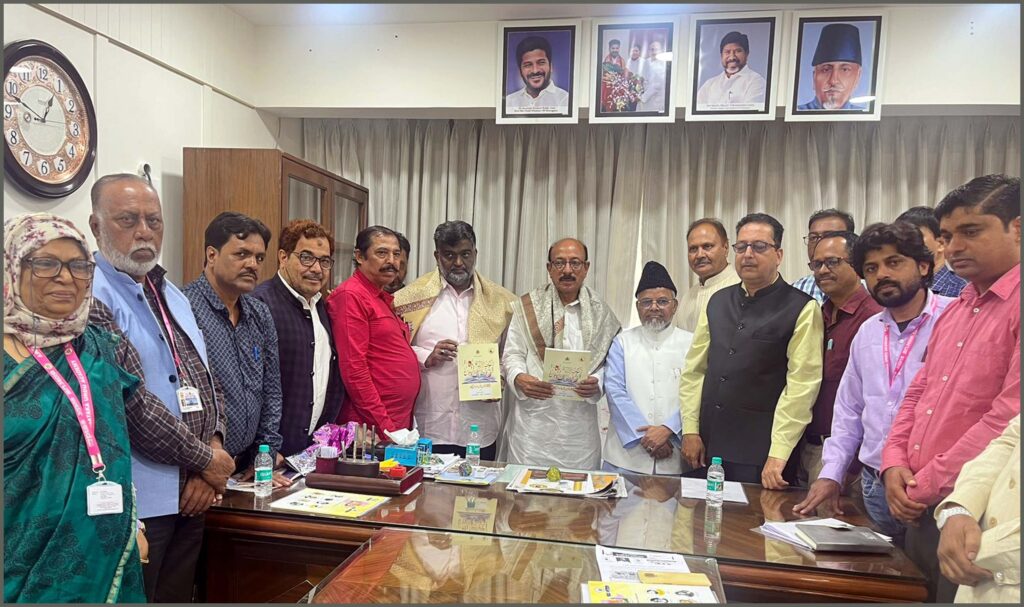
Warangal: In celebration of India’s 78th Independence Day, Azizia Perfumes organized a special event titled “An Evening with Like-Minded People in Warangal” at Golden Guest House. The event featured moving tributes to the martyrs through patriotic songs, ghazals, and film melodies performed by Mr. Mohammad Abdul Aleem Javed, Mr. S.M. Saeed, Mr. Akbar Zia, Mr. Aleem Danish, Mr. Mohammad Habibuddin, and Mr. Mohammad Akhtar Hussain.
The gathering saw enthusiastic participation from notable attendees, including Mr. Iqbal Dard, Mr. Syed Abdul Hafeez, Mr. Khwaja Kaifi, Mr. Ameeruddin Ameer, Mr. Mirza Fazil Baig, Mr. Khwaja Shakeel Ahmed, and Engineer Yousuf.
The event’s success was further ensured by the dedicated hosting efforts of Mirza Fathullah Baig Riyaz, Mohammad Jafar, Mashooq Sharif, Syed Nizamuddin, Mohammad Hussain Pasha, Mohammad Abid, Mohammad Saleem, and Ramzan Ali. Special thanks to DastoorNews.com
Hyderabad, August 17, 2024 – On Saturday evening, Vikarabad Town and several areas in Vikarabad District experienced heavy rainfall, bringing much-needed relief from the intense heat that has been affecting the region.
The downpour, which began in the late afternoon and continued into the evening, resulted in a significant drop in temperatures, providing a respite from the sweltering heat that has prevailed over the past few weeks. The rain also contributed to easing the water scarcity issues in some areas, although it has led to minor disruptions in local transportation and waterlogging in a few spots.
Weather experts have indicated that this rainfall is part of a broader weather pattern affecting Telangana, and more such showers may be expected in the coming days. The rain is expected to positively impact local agriculture by improving soil moisture levels, which are crucial for crop growth during this crucial period of the agricultural cycle.
Residents of Vikarabad Town and surrounding areas are advised to remain cautious due to potential waterlogging and intermittent showers. Authorities are working to manage the situation and ensure that any disruptions caused by the rain are addressed promptly.
Washington, August 17, 2024 – In a significant setback for Tahawwur Rana, a Pakistani-origin Canadian businessman sought by India for his alleged role in the 2008 Mumbai terror attacks, the US Court of Appeals for the Ninth Circuit has ruled that he is extraditable to India under the existing extradition treaty between the two nations.
The ruling, delivered by a panel of three judges—Milan D. Smith, Bridget S. Bade, and Sidney A. Fitzwater—affirmed the decision of the District Court in the Central District of California, which had previously denied Rana’s habeas corpus petition. Rana had challenged the magistrate judge’s certification of his extradition to India, citing the Non Bis in Idem (double jeopardy) exception under the treaty.
The court ruled that the treaty’s provisions allow Rana’s extradition, as the charges in India involve distinct elements separate from those for which Rana was acquitted in the United States. The panel rejected Rana’s argument that the double jeopardy clause should prevent his extradition, emphasizing that the term “offence” in the treaty refers to a charged crime rather than underlying acts.
Rana was previously tried and convicted in the US for providing material support to a terrorist organization involved in planning attacks in Denmark, though he was acquitted of charges related to the Mumbai attacks. After serving seven years in prison, India requested his extradition to face trial for his alleged involvement in the 2008 attacks.
Despite this ruling, Rana retains the option to appeal, and his legal battle against extradition may continue.
Hyderabad, August 17, 2024 – The Orators’ Club, under the Department of English at Muffakham Jah College of Engineering and Technology (MJCET), celebrated its Annual Day with great enthusiasm. The event saw a large gathering of faculty, students, and members of the Orators’ Club.
The occasion was graced by the presence of Dr. Mahipal Rawat, Principal of MJCET, Dr. Ferhatulla Hussaini, Dean, Prof. Abdul Majeed, Head of the BS&H Department, and other esteemed faculty members. The students were commended for their exemplary contributions by the distinguished guests, who encouraged them to value time and focus on both academic and extracurricular activities.
Dr. Gitasri Mukherjee, Coordinator of the Department of English, emphasized the importance of maintaining a collaborative spirit to help the club achieve greater success. The celebration featured the release of the club’s newsletter and magazine, Vestige, a review of the club’s achievements over the year, and the presentation of mementos. The new Governing Body was also announced during the event.
Chief Coordinators of the club shared their experiences and the lessons learned during their tenure. The event concluded with a formal farewell and the distribution of Letters of Appreciation to the team.
In a strong statement, Supreme Court lawyer and human rights activist Prashant Bhushan has condemned India’s decision to export arms to Israel, asserting that it equates to aiding genocide. Bhushan highlighted that Article 21 of the Indian Constitution, which guarantees the protection of life and personal liberty, is not confined to Indian citizens alone. He argued that the Constitution clearly states that the State of India cannot violate anyone’s rights under Article 21, regardless of whether they are citizens or non-citizens. This, he stressed, extends to India’s actions on the global stage, including its arms exports.
Bhushan’s remarks have ignited a broader discussion regarding India’s foreign policy and its impact on global human rights. Critics of the arms trade argue that these exports may indirectly contribute to civilian suffering in conflict zones, while proponents claim they are part of essential strategic alliances and defense partnerships.
The timing of Bhushan’s comments is particularly significant as they come amidst escalating violence in the Gaza Strip and the West Bank, where countless civilians have been affected. His statement serves as a call for India to reconsider the ethical implications of its defense exports, especially given the country’s historical stance on non-alignment and support for the Palestinian cause.
This issue underscores the complex relationship between national interests, international diplomacy, and moral obligations in global affairs.
In a significant drug bust, the Madhapur Special Operations Team, in collaboration with Raidurgam police, arrested three drug peddlers and five consumers at Telecom Nagar on Thursday. The operation led to the seizure of 620 grams of heroin paste valued at Rs 4.34 crore, along with two cars and eight mobile phones, bringing the total worth of the seized items to Rs 4.65 crore.
The arrested individuals include three drug suppliers from Pali, Rajasthan—M. Choudary, Dinesh Choudary, and Ganesh Choudary. The primary supplier, Savar Jhat, also from Rajasthan, is currently absconding. The consumers apprehended are Nithin Gurjar from Gachibowli, Prakash Choudary from Saidabad, JV Dewasi from Ameenpur, Prakash Choudary from Sainikpuri Colony, and Banaram Choudary from Bhongir—all natives of Rajasthan and Madhya Pradesh.
According to police, the trio of Dinesh, Ganesh, and Mangalram sought quick profits through drug peddling and placed an order for heroin paste from their supplier, Savar Jhat, after paying a Rs 48,000 advance. On August 7, Savar Jhat delivered 620 grams of heroin paste to them in Hyderabad.
The accused then assembled a team to distribute the drug, recruiting Ramesh, Chandu, and Suresh from Rajasthan for the task, offering them Rs 7,000 each. The team stayed at a hotel near Radhika X Road in ECIL before moving to a shop in Gachibowli, owned by Prakash Choudary, to conceal the drugs.
Acting on a tip-off, the SOT and Raidurgam police apprehended the suspects and seized the contraband. The consumers were arrested based on confessions obtained during the investigation. Efforts are ongoing to capture the remaining suspects, with Raidurgam police continuing the investigation.
Election Roadmap Unveiled: Chief Election Commissioner Rajiv Kumar addresses the media, detailing the upcoming assembly elections in Jammu and Kashmir.
For the first time in ten years, Jammu and Kashmir will witness assembly elections, marking a significant political event since the last elections held in 2014. Chief Election Commissioner Rajiv Kumar announced on Friday that the elections will be conducted in three phases, with voting scheduled for September 18, 25, and October 1. The counting of votes will take place on October 4.
Rajiv Kumar highlighted the region’s embrace of the democratic process, noting that the people of Jammu and Kashmir “chose ballots over bullets.” This was evident in the recent parliamentary elections, where voter turnout reached 58.46%, the highest in 35 years.
Jammu and Kashmir, which has a total of 90 Assembly constituencies, including 74 general, nine reserved for Scheduled Tribes (ST), and seven for Scheduled Castes (SC), has 87.09 lakh registered voters, with 44.46 lakh male and 42.62 lakh female voters.
In preparation for the elections, the Election Commission has directed the Union Territory administration to transfer officers from their home districts, a standard procedure to ensure fairness. This directive is part of the Commission’s policy to prevent officers from serving in their home districts or areas where they have served for extended periods.
In a related development, the Jammu and Kashmir administration implemented a major reshuffle in the police force, transferring several senior officers and appointing a new chief for the intelligence wing. This followed the recent appointment of senior IPS officer Nalin Prabhat as the Special DG of Jammu and Kashmir Police, who will assume leadership after R.R. Swain’s retirement on September 30.
Reflecting on the robust political participation in the region, Kumar stated, “During Lok Sabha elections in J&K, people were eager to participate… There was thriving political participation throughout the election… We want the layers of democracy to be strengthened in J&K.”
The last assembly elections in Jammu and Kashmir, including Ladakh, were conducted in five phases in 2014, and this year’s election is expected to follow a similar multi-phase format. The elections come after Jammu and Kashmir, India’s only Muslim-majority region, had its special status revoked by the central government in 2019, resulting in its reorganization into two Union Territories. The election panel reports that nearly 9 million people are registered to vote in the upcoming election for the 90-member legislative assembly.
#WATCH | More than 20 lakh voters in J&K elections would be young voters, and we want to focus on them as ambassadors of our elections: Rajeev Kumar, Chief Election Commissioner of India (CEC)
Union Minister Kiren Rijiju Inaugurates Haj 2025 Application Process
The Government of India has initiated the Haj 2025 preparation process early, with applications now open for aspiring pilgrims. Union Minister for Minority Affairs, Kiren Rijiju, officially launched the application process, marking the first time that applications are being accepted via the Haj Suvidha App alongside the official website of the Haj Committee of India. Saudi Arabia has allotted a quota of 1,75,025 pilgrims for India in 2025.
Haj Suvidha App: A Step Forward
The Haj Suvidha App, introduced during Haj 2024, is a significant reform aimed at making the pilgrimage experience more convenient. The app offers a range of features, including training content, accommodation and flight details, emergency services, and more, all aimed at improving coordination and control of pilgrims by the Indian administration in Saudi Arabia.
Government Reforms and Initiatives
Continuing its trajectory of reforms, the Government of India has reduced the age criteria for mandatory companions from 70 to 65 years due to the strenuous nature of the pilgrimage and harsh climatic conditions in Saudi Arabia. Pilgrims aged 65 or above will now be given the highest priority in allotment.
In another significant administrative measure, the requirement for depositing physical passports with the Haj Committee of India for 4-5 months has been removed, and passport offices have been instructed to expedite the issuance of passports for Haj purposes.
Enhanced Support and Services
To better aid, assist, and guide pilgrims during Haj 2025, the ratio of State Haj Inspectors to pilgrims has been improved from 1:300 to 1:150. Additionally, rigorous training will be provided to trainers, government officials, and pilgrims to ensure better sensitization, coherence, and discipline during the pilgrimage.
Banking and Healthcare Improvements
Domestic Systemically Important Banks (D-SIB) will provide customized banking services for Haj pilgrims throughout the country, including at Embarkation Points. In terms of healthcare, the medical history and current physical condition of all intending Haj pilgrims will be evaluated, with health cards linked to the Haj Suvidha App for easy data access and response in case of medical emergencies.
The Government’s proactive approach and series of reforms are aimed at ensuring a smoother and safer Haj pilgrimage for Indian citizens in 2025.
Hyderabad, August 13 – A delegation of 15 members, led by Muhammad Ali Qazi, Chairman of the Karnataka Urdu Academy, visited the Telangana Urdu Academy’s head office today. The delegation was warmly welcomed by Tahir Bin Hamdan, President of the Telangana Urdu Academy.
During the meeting, the presidents of the two academies discussed various projects and initiatives being undertaken in Karnataka and Telangana to promote and develop the Urdu language and literature. A significant outcome of the meeting was the mutual agreement to establish a Federation of South Indian Urdu Academies, which will include Telangana, Karnataka, Andhra Pradesh, Tamil Nadu, and Kerala. This federation aims to nurture young and talented Urdu writers and poets from South India and help develop their skills.
Additionally, the meeting emphasized the importance of exchanging ideas between the two academies and enhancing existing schemes to further the promotion of the Urdu language. Shaik Liyakat Hussain, Director/Secretary of the Telangana Urdu Academy, provided a detailed presentation on the academy’s schemes.
Special guest Prof. Ehtesham Ahmed Khan from the Department of Mass Communication and Journalism at Maulana Azad National Urdu University, Hyderabad, offered to enhance coordination for organizing orientation programs for Urdu journalists.
Other attendees from the Karnataka Urdu Academy included Mohammed Azam Shahid, Mohammed Shahid Khaji, Dr. Anees Siddiqui, Syed Abid Aslam, Ms. Syeda Akhtar Khanum, Abdul Azim Tanveer, Mohammed Aminuddin Nawaz, Sharifuddin Mokashi, Natiq Ali Puri, Dr. Maaz Uddin Khan, Registrar Nagaraj, Under Secretary of the Minority Welfare Department, Finance Member, and other staff members.
Officials and staff from the Telangana Urdu Academy, including Superintendent , V. Krishna, Attaullah Khan were also present. The Chairman and Registrar of the Karnataka Urdu Academy extended an invitation to the president and officials of the Telangana Urdu Academy to visit Karnataka and observe their academy’s activities and performance.
Hyderabad: The mess facility for research scholars at Osmania University (OU) has once again been flooded following heavy rains on Tuesday, turning the dining area into an indoor pool. Videos circulating among research scholars show students forced to dine in waterlogged conditions, with water reaching ankle level on the floor.
In one of the videos, two students, one clad in a raincoat, can be seen manually scooping rainwater from the floor into a bowl, highlighting the severity of the situation.
According to new research scholars residing in the hostel, the waterlogging is due to persistent seepage from the rooftops. “This ongoing issue is unacceptable. Initially, water seepage affected only a single table, but now the entire rooftop is leaking, causing widespread waterlogging in the dining hall,” said Satya Nelli, a research scholar from the Political Science department at Arts College.
The research scholars also reported that the water seepage is not confined to the dining hall; it extends to the storeroom as well, raising concerns over potential health risks such as mold growth and sanitation problems.
This incident mirrors a similar situation from last year when research scholars, led by Satya, staged a protest by eating their meals on the waterlogged floor. Despite repeated assurances from the university administration, the problem has persisted for several years.